


BRAND CASE STUDY 02
They didn’t need to go this hard for a salad.
That’s exactly why it works.
There are brands that market what they sell.
And then there are brands that build something much bigger around it.
Mandy’s sells salads.
But over more than two decades, sisters Mandy and Rebecca Wolfe have turned a relatively simple product into a highly recognizable Canadian brand—one that now extends across restaurants, cookbooks, grocery products, merchandise and an expanding national footprint.
Then came the commercial.
Instead of making salad look appetizing and calling it a day, Mandy’s went considerably further.
They built a fairytale.
And that decision tells us a lot about the difference between marketing a product and building a brand.
Mandy’s Could Have Made a Salad Commercial. Instead, They Built a Fairytale.
This is where Mandy’s really caught our attention.
The premise could have been simple:
Beautiful ingredients.
Colourful salads.
Someone taking a bite.
Logo.
Done.
Instead, Mandy’s created a cinematic fairytale around the product.
Characters. Costumes. Sets. Production design. Storytelling. Visual effects. An entire imagined world built around something as everyday as lunch.
The scale is intentionally disproportionate to the product.
And that’s precisely what makes it interesting.
Because Mandy’s wasn’t simply asking:
How do we make our salad look good?
They were asking a much bigger question:
How big can this brand feel?
That shift—from product thinking to brand thinking—is where the lesson begins.
The Product Stayed Simple. The Idea Got Bigger.
There is a tendency, particularly in hospitality, tourism and lifestyle businesses, to let the category dictate the marketing.
A restaurant markets food.
A hotel markets rooms.
A winery markets wine.
A destination markets things to do.
Mandy’s offers another possibility.
The product doesn’t necessarily need to become more complicated for the brand around it to become more interesting.
A salad can have a cinematic campaign.
A restaurant can have a point of view.
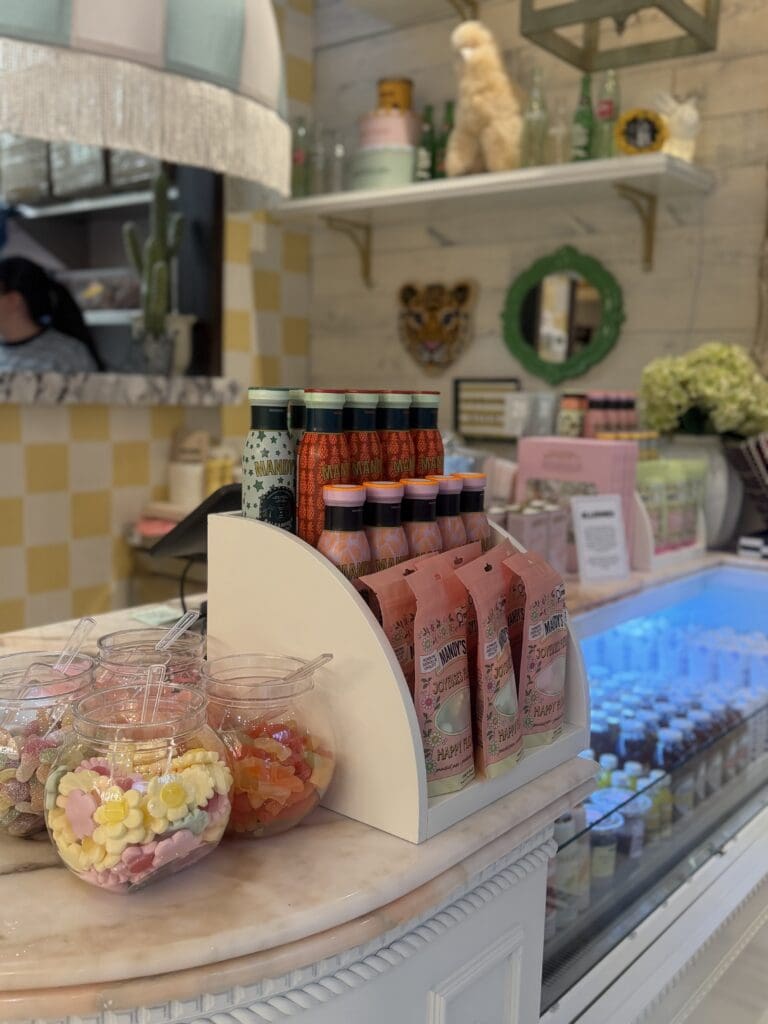
Packaging can have personality.
An interior can tell a story.
A neighbourhood can influence a location.
A simple customer interaction can become a recognizable brand moment.
You don’t necessarily need a bigger product. You need a bigger idea around it.
But the Commercial Only Works Because the Brand Already Exists
This might be the most important part of Mandy’s story.
The fairytale wasn’t used to manufacture a personality the company didn’t already have.
It amplified one Mandy’s had been developing for years.
When Mandy and Rebecca Wolfe opened their first create-your-own salad bar in the back of a Montreal women’s clothing store in 2004, they naturally divided their strengths.
Mandy developed the food.
Rebecca designed the space.
That relationship between product and environment has continued as the company has grown.
Today, Mandy leads food and culinary development, while Rebecca continues to design Mandy’s locations and leads Brand Marketing.
Look across the business and you can see the result.
The colourful interiors.
The typography.
The packaging.
The photography.
The language.
The cookbooks.
The retail products.
The merchandise.
The restaurants themselves.
Each is a layer.
Together, they create recognition.
That’s the difference between having a campaign and having a brand.

Then Mandy’s Brought the Brand to Vancouver
In September 2026, Mandy’s opened its first Vancouver location in the Kitsilano neighbourhood.
And this is where the story became particularly interesting to us.
Expansion creates a challenge for any experience-led brand:
How do you grow without becoming generic?
The easiest approach is replication.
Find the formula. Copy it. Put the logo above the door.
But Mandy’s didn’t reinvent the formula for Vancouver — and they didn’t abandon it either.
The core menu and recognizable brand remain intact. Instead, they layered in a sense of place.
The 800-square-foot express location incorporates warm yellows, soft pinks, palms and beach-inspired details referencing its proximity to the water and the energy of Kitsilano.
And rather than creating an entirely new menu, Mandy’s introduced one Vancouver-exclusive item: Salmon by the Sea, a salad built around smoked salmon and flavours inspired by the West Coast.
It’s a relatively small addition.
But strategically, that’s what makes it interesting.
Mandy’s didn’t need to change who they are to acknowledge where they are.
It’s still Mandy’s. But it’s Mandy’s in Kitsilano.
That distinction matters.
Consistency Doesn’t Have to Mean Sameness
One of the most interesting things about strong brand systems is knowing what should remain consistent—and what should be allowed to change.
Mandy’s doesn’t need every restaurant to look identical for every restaurant to feel like Mandy’s.
The recognizable personality remains.
Colour.
Playfulness.
Food presentation.
Language.
Design.
A sense that healthy eating doesn’t need to feel clinical or overly serious.
But place is allowed into the experience.
That gives the brand room to grow without stripping individual locations of personality.
For hospitality brands in particular, this is an important distinction:
Consistency builds recognition. Sameness can erase character.
The strongest systems leave room for both.

The Details Are Doing More Work Than They Look Like
This is something we pay close attention to at Grant Communications.
Customers rarely walk into a restaurant and consciously catalogue its brand strategy.
They don’t say:
Excellent use of brand codes.
They simply know how the place makes them feel.
That feeling is usually being created by dozens of small decisions working together.
The signage.
The menu.
The packaging.
The colours.
The language.
The food presentation.
The music.
The service.
The merchandise.
The things someone instinctively photographs.
None of these moments has to carry the brand on its own.
But when enough of them reinforce the same idea, the experience starts to feel unmistakable.
That is where branding moves beyond a logo or campaign.
It becomes something a customer actually experiences.
Mandy’s Understands the Power of a Signature
There’s another lesson hiding in something as simple as Salmon by the Sea.
Mandy’s could have entered Vancouver with its established menu alone.
Instead, it gave the new market something of its own.
This isn’t about whether one salad changes the business.
It’s about what the gesture communicates.
It signals something simple: this was created with this place in mind.
Signature products, rituals, collaborations, amenities and moments can create disproportionate value because they give people something specific to discover, remember and talk about.
And importantly, they create stories.
“Have you tried Mandy’s?” is one conversation.
“Have you tried the Vancouver-only salad?” is another.
The second gives the customer something to pass along.
Mandy’s Isn’t Just Selling Salad. It’s Creating Belonging.
People can buy salad almost anywhere.
So how does a salad brand become something people recognize, seek out and want to be associated with?
This is where brand becomes more than awareness.
Mandy’s has built a distinctive enough identity that the experience says something beyond what’s in the bowl.
The aesthetic.
The personality.
The spaces.
The products.
The humour.
The balance of wellness and indulgence.
Together, these cues create something customers can recognize themselves in—and want to be part of.
And when people start photographing the space, carrying the packaging, talking about the brand and weaving it into their routines, something else happens:
They’re no longer just consuming the product.
They’re helping carry the brand forward.
The customer becomes part of the media.
What Brands Can Learn From Mandy’s
The takeaway isn’t:
Spend more on advertising.
And it certainly isn’t:
Make a cinematic commercial.
It’s much more useful than that.
Stop asking only:
How do we market what we sell?
Start asking:
What exists around what we sell?
What does our brand feel like?
What do people remember?
What could only belong to us?
What are our recognizable codes?
What is worth photographing?
What becomes a ritual?
What can change from location to location without losing the brand?
What is our version of Salmon by the Sea?
And perhaps most importantly:
Are we giving people something bigger to connect with than the transaction itself?
Because memorable brands aren’t usually created by one enormous idea.
They’re created when hundreds of small decisions start telling the same story.
The commercial simply turns up the volume.

The Grant Communications Perspective
At Grant Communications, we’re interested in what happens beyond the product.
The story around it.
The feeling around it.
The physical experience of it.
The details customers remember.
The moments they share without being asked.
And the layers that transform an otherwise good business into something distinctive enough to become memorable.
Mandy’s is an interesting example because the product itself hasn’t had to become extraordinarily complicated.
The thinking around it has.
That’s where brand becomes experience.
And where experience can become belonging.
BUILD SOMETHING PEOPLE REMEMBER.
Great brands don’t stop at what they sell.
We help hospitality, tourism and lifestyle brands uncover the stories, experiences and signature moments that give people more reasons to notice, remember and return.
Explore Layered Experiences™
Grant Communications
PR. BRAND. EXPERIENCES.
This case study is an independent analysis by Grant Communications. Grant Communications is not affiliated with Mandy’s and was not involved in the development of the brand, campaign, or customer experience discussed above.


comments +